Showing posts with label Buddhism. Show all posts

Wednesday, November 2, 2016

Taking Refuge


Taking Refuge
ingredients: antique handwritten letter fragments, Italian currency, vintage ephemera, image transfers, ginko leaf, monoprint


To take refuge is to commit oneself to the Buddhist path. According to Chögyam Trungpa Rinpoche:

"In the Buddhist tradition, the purpose of taking refuge is to awaken from confusion and associate oneself with wakefulness. Taking refuge is a matter of commitment and acceptance and, at the same time, of openness and freedom. By taking the refuge vow we commit ourselves to freedom.

“I take refuge in the Buddha.
I take refuge in the dharma.
I take refuge in the sangha.”

So becoming a refugee is acknowledging that we are homeless and groundless, and it is acknowledging that there is really no need for home, or ground. Taking refuge is an expression of freedom, because as refugees we are no longer bounded by the need for security. We are suspended in a no-man’s land in which the only thing to do is to relate with the teachings and with ourselves."


Tuesday, December 29, 2015

Weekly Quick Collage: Copper Cliff

Back to my weekly quick collages, and hopefully, posting much more regularly.

Copper Cliff
collage, 5.5 x 5 inches


Instead of the short quotes I usually post with my collages, I thought I'd share with you some thoughts on mindfulness and happiness from philosopher, Zen Buddhist, Episcopal priest and spiritual teacher Alan Watts.  This comes from an article by Maria Popova entitled, "An Antidote to the Age of Anxiety: Alan Watts on Happiness and How to Live with Presence", which you can find in its entirety here.


"What keeps us from happiness, Watts argues, is our inability to fully inhabit the present:

The “primary consciousness,” the basic mind which knows reality rather than ideas about it, does not know the future. It lives completely in the present, and perceives nothing more than what is at this moment. The ingenious brain, however, looks at that part of present experience called memory, and by studying it is able to make predictions. These predictions are, relatively, so accurate and reliable (e.g., “everyone will die”) that the future assumes a high degree of reality — so high that the present loses its value.

But the future is still not here, and cannot become a part of experienced reality until it is present. Since what we know of the future is made up of purely abstract and logical elements — inferences, guesses, deductions — it cannot be eaten, felt, smelled, seen, heard, or otherwise enjoyed. To pursue it is to pursue a constantly retreating phantom, and the faster you chase it, the faster it runs ahead. This is why all the affairs of civilization are rushed, why hardly anyone enjoys what he has, and is forever seeking more and more. Happiness, then, will consist, not of solid and substantial realities, but of such abstract and superficial things as promises, hopes, and assurances."


For most of us, mindfulness, or being completely in the present moment, is very difficult. Yet it seems we would almost certainly be happier if we could achieve this. What, then, is the best way to go about finding this mental state of "presence"? 


Tuesday, July 28, 2015

Weekly Quick Collage: Kwan Yin


Kwan Yin
collage, 6 x 5 inches


The goddess Kwan Yin, also known as Guanyin, Kwannon, and many other similar names, is ubiquitous among Asian religions. According to Wikipedia:

"Guanyin is an East Asian deity of mercy, and a Bodhisattva (an elightened being who vows to reincarnate until all beings are enlightened) associated with compassion as venerated by Mahayana Buddhists. The name Guanyin is short for Guanshiyin, which means "Perceiving the Sounds (or Cries) of the World". She is also sometimes referred to as Guanyin Bodhisattva. ....

...It is generally accepted among East Asian adherents that Guanyin originated as the Sanskrit Avolokitesvara. Commonly known in English as the Mercy Goddess or Goddess of Mercy, Guanyin is also revered by Taoists as an immortal. In Chinese folk religion there are mythical accounts about Guanyin's origins that are not associated with the Avalokiteśvara described in Buddhist sutras."


As an aside, I'm honored to say that my artwork has been published in Alisa Golden's lovely literary magazine, *82 review, issue 3.2. Check it out here. Many thanks to Alisa for the honor.


Monday, November 17, 2014

In Tara's Garden


In Tara's Garden
9.5 x 15.75 inches
ingredients: vintage book cover, image transfers, acrylic ink, Derwent watercolor pencils, cut-outs, metallic pens, Pitt artist pens, monotype, woodblock prints, found objects, brads


Tara is known primarily as the Tibetan Buddhist bodhisattva (enlightened being) of compassion and action.  According to Wikipedia, "Tārā came to be seen as an expression of the compassion of perfected wisdom... Tārā is also known as a saviouress, as a heavenly deity who hears the cries of beings experiencing misery in sansara (the cycle of suffering, death, and re-birth)."


Tara is one of the earliest known dieties; her origins are not entirely clear, but some scholars believe she may come from pre-Buddhist animist religions in Tibet. She has many different forms or aspects, of which Green Tara is one of the most popular. Green Tara (Khadiravani) is usually associated with protection from fear.


According to wildmind Buddhist meditation, "Green Tara is a forest goddess, and in one story is shown as being clad in leaves. Her Pure Land, in distinction to others that are composed of precious gems, is said to be lush and verdant:
Covered with manifold trees and creepers, resounding with the sound of many birds,
And with murmur of waterfalls, thronged with wild beasts of many kinds;
Many species of flowers grow everywhere.
She is therefore a female form of the "Green Man" figure who is found carved in many European churches and cathedrals, and who is found in the Islamic traditions as the figure Al-Khidr."


Thursday, July 10, 2014

Paradox II

Quantum Theory forces us to see the universe not as a collection of physical objects, but rather as a complicated web of relations between the various parts of a unified whole.
                                                                                                      ~ Fritjof Capra, The Tao of Physics


Things derive their being and nature by mutual dependence and are nothing in themselves.
                                                                                                         ~ Nagarjuna (Buddhist philosopher)


Paradox II
ingredients: vintage book cover; vintage book pages, stamps, and other ephemera; vintage typewriter keys and game piece; pencil drawing; image transfers; watercolor pencils; gold oil crayon


In Eastern mysticism, the universal interwovenness always includes the human observer and his or her consciousness, and this is also true in atomic physics. At the atomic level, 'objects' can only be understood in terms of the interaction between the processes of preparation and measurement. The end of this chain of processes lies always in the consciousness of the human observer.
                                                                                                          ~ Fritjof Capra, The Tao of Physics


Like the Eastern Void, the 'physical vacuum' - as it is called in field theory - is not a state of mere nothingness, but contains the potentiality for all forms of the particle world.
                                                                                          ~ Gary Zukav, The Dancing Wu Li Masters


If you're interested in these ideas, here's some further explanation:


Something to think about, right?


Thursday, May 8, 2014

The Dharma and the Dao


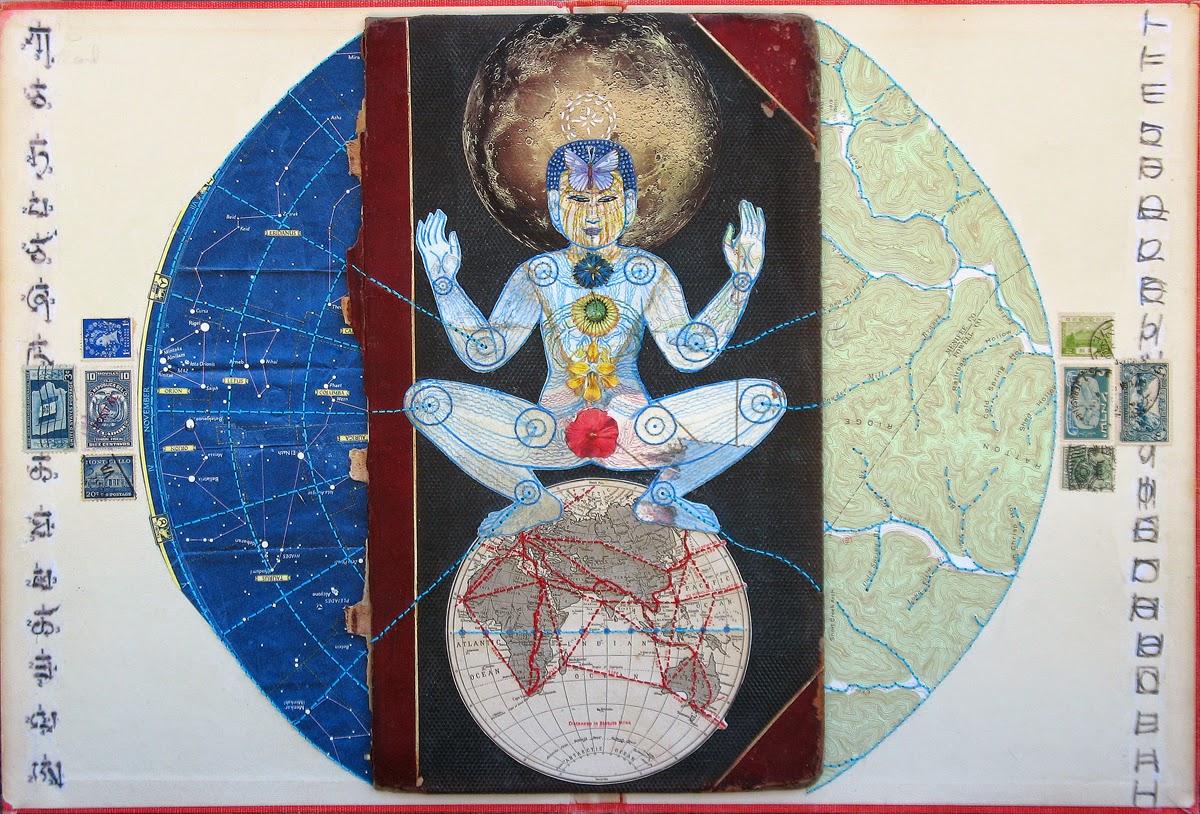
This piece took form very organically, though it probably doesn't look like it. I had this figure from an earlier work that had just never worked out, and I really didn't think it was likely that I'd ever find a use for him. I copied him from an ancient Chinese or Tibetan medical drawing (minus a bunch of the tiny pathways), showing the pathways of energy movement through the body. Apparently they saw the human energy/astral body as having only five chakras at that time; I represented 4 of these as flowers and one as a butterfly. (Later I added the crown chakra in the form of a stitched 'star'.)

 Anyway, I had cut out the eastern hemisphere from a vintage atlas and ended up not using it on the previous piece; somehow they ended up together, and I thought, well, maybe... Then I remembered the moon I had cut out for something else. They looked alright together on the ledger cover I had just taken apart, but it was pretty boring., and seemed too large for the narrow cover. I then played around with the idea of placing the ledger cover on top of a larger one, but the only one that was really large enough was, well - a LOT larger.

Now I had the opposite problem - what to do with all that empty space. I decided that since the design was very centered and simple, it might be best to stick with that, and also to continue with the circle motif. Oddly enough, I immediately opened one of my map drawers and found this beautiful semi-circular piece of a star map that was just the right size.  When that happens, I figure I've got to go with it; I cut out a piece of  a topographical map the same size for the other side.

Whenever I see a design that's very balanced and symmetrical, I think of yin and yang, and the dao.  With this piece, I began to see the left side, which is marked off in regular and specific increments, as the more civilized, regimented part, associated with learning to do things a certain way.  The right side became for me the side of nature, unpredictable and meandering, like the rivers I stitched. So the left side was the dharma - the Buddhist teachings, while I have always connected Daoism with nature. I have always seen Buddhism and Daoism as being quite compatable, and many of their philosophies seem to overlap.  One idea common to both of them is that everything is connected, part a whole. I wanted to emphasize that humans are part of that whole by having the stitched lines on both sides leading into the circles on the figure.

The edges were empty, so I chose two different types of characters to embellish them with: Tibetan letters with instructional arrows to represent the teachings (dharma), and very early primitive Chinese characters to represent the dao (nature) side. This piece is very logical compared to most of my work, and so I felt the title had to be The Dharma and the Dao.  My other possible choice was Toward the One.  What do you think?


“The Formless Way
We look at it, and do not see it; it is invisible.
We listen to it, and do not hear it; it is inaudible.
We touch it, and do not feel it; it is intangible.
These three elude our inquiries, and hence merge into one.

Not by its rising, is it bright,

nor by its sinking, is it dark.
Infinite and eternal, it cannot be defined.
It returns to nothingness.
This is the form of the formless, being in non-being.
It is nebulous and elusive.

Meet it, and you do not see its beginning.

Follow it, and you do not see its end.
Stay with the ancient Way
in order to master what is present.
Knowing the primeval beginning is the essence of the Way.” 
― Lao Tzu (Daoism)


The Heart Sutra  (Buddhism)

...form does not differ from emptiness;
emptiness does not differ from form.
Form itself is emptiness; emptiness itself is form.
So too are feeling, cognition, formation, and consciousness.
Shariputra, all Dharmas are empty of characteristics.
They are not produced, not destroyed, not defiled, not pure;
and they neither increase nor diminish.
Therefore, in emptiness there is no form, feeling, cognition, formation, or consciousness;
no eyes, ears, nose, tongue, body, or mind;
no sights, sounds, smells, tastes, objects of touch, or Dharmas;
no field of the eyes up to and including no field of mind consciousness;
and no ignorance or ending of ignorance,
up to and including no old age and death or ending of old age and death.
There is no suffering, no accumulating, no extinction, and no Way,
and no understanding and no attaining.
Because nothing is attained,
the Bodhisattva through reliance on Prajna Paramita is unimpeded in his mind.
Because there is no impediment, he is not afraid,
and he leaves distorted dream-thinking far behind.
Ultimately Nirvana!


Monday, April 21, 2014

Blueprint for Enlightenment II


Blueprint for Enlightenment II
ingredients: vintage book cover, vintage ephemera, woodblock prints, image transfer, Derwent Inktense watercolor pencil, vintage game pieces, metallic gel pen

I had lots of fun with this piece, just allowing myself to play with materials without giving much thought to what it all means.  I called it Blueprint for Enlightment II, mainly because the bright blue pencil I used reminds me of the color in a cyanotype/blueprint, and because the drawing is of the Tibetan Buddhist bodhisattva Avalokitesvara. He is often depicted woth 1000 arms and 11 heads, but I left off most of the arms as well as some of the heads in my version.


"According to Mahāyāna (Buddhist) doctrine, Avalokiteśvara is the bodhisattva (enlightened being) who has made a great vow to assist sentient beings in times of difficulty, and to postpone his own Buddhahood until he has assisted every sentient being in achieving Nirvana.... [The Chinese version of] this bodhisattva is variably depicted as male or female, and may also be referred to simply as Guanyin."  (Wikipedia)


"It is said that the personification of perfect Compassion, Avalokiteshvara (Guanyin) Bodhisattva (a great being who aspires to help all sentient beings be free of suffering before entering the bliss of Buddhahood), in the beginning of His/Her Bodhisattva career of helping sentient beings, vowed that "Should He ever become disheartened in saving sentient beings, may His body shatter into a thousand pieces." This might seem extreme, but it was symbolic of His overwhelming great Compassion and determination.

One day, while helping beings in a higher realm, He looked down into the hells which He had emptied through the teaching of the Dharma, and realised, to His dismay, that countless beings were still flooding into them. In a moment of exasperation, He became so disheartened that true to His vow, His body shattered in great agitation and despair. Despite this, He did not just give up — His consciousness beseeched the Buddhas for help. Of the Buddhas who came to aid Him, one was Amitabha Buddha, who became His Guru (personal teacher) Buddha. With the Buddha's miraculous powers, He attained a new form — one with a thousand helping hands of Compassion coupled with the eyes of Wisdom in each palm. With this, He renewed His vow to saving not just limited sentient beings, but all sentient beings."  (Buddhist Studies)


Friday, July 16, 2010

Buried Treasure: A Matter of Time/ Time and Time Again

Seth Apter of The Altered Page had a great idea, as usual.  He thought we should re-post one of our favorites from the past, as everyone may not have read it, and he would then post, on his blog, the links to all this BURIED TREASURE.  I thought this was brilliant, because I'm a slow-poke who often doesn't keep up with my blog reading.  Which brings me to the topic at hand: TIME.
(I kind of cheated because mine's a two-parter.)

  PART 1: A Matter of Time
Persistence of Memory, Salvador Dali

Time has become somewhat of an issue with me lately.  To put it bluntly, I've been very stressed out about it, or, more specifically, about a lack of it.  When I'm doing anything, particularly artwork, I feel guilty about the 400 other things I should be doing.  A lot of these things just don't get done.  For example:

Cleaning the house - I mean really, doesn't it just get dirty again almost immediately?  There's practically no reward in it whatsoever!  Yet it must be done- again and again and again.

Cooking - The same thing only worse.  It takes at least four times as long to cook something as it does to eat it.  Then you have to clean it up!  

Errands - Do I really need to go to the post office, get the car washed, or buy laundry detergent?  I'm willing to bet no one ever died from not doing any of those things.  Which reminds me-

Laundry - Ugh!  Can't I just throw the dirty clothes away and buy new ones?  No, wait, which takes less time, washing clothes or going shopping?  Maybe I could just order them online, yeh, that might work... but it would be awfully expensive.  I'd have to get a second job, but then I'd have even less time to do what I want.  Aaaaaaaaaghh!!

Of course, the things listed above are only the proverbial tip of the iceberg.  I think you can see my problem.  I just can't seem to find much time to make art.  It can literally take me days to do a blog post!   And the business side of it, well, forget it!  I have to choose- I can do art, or do the business, but not both.  Without the art, business is beside the point, and the art without trying to sell it is...well, not getting me any closer to doing it full time.

All of this results in me feeling pressured and nervous, always fretting about something I don't have time to do.  Not very Zen, eh?  So, since I can't get this time thing off my mind, I thought I'd use my blog to do a little exploration of time.  I mean, what is it, actually?  Why does time seem to zip by when we're doing something we enjoy, but crawl so slowly when we're, say, sitting through a boring class, or waiting in line?

Salvador Dali

Timothy Ferriss,  Four-Hour-A-Week Entrepreneur, states: "Conceptually, time is the framework that allows us to put experience on a continuum. Practically, time is a non-renewable resource that determines the redeemable value of almost all renewable resources on a personal level. Income, for example, cannot be traded for experience without the requisite hours or minutes. Time is the master limiting factor."  

Oh yeah, I hear that, Timothy!

 Nude Descending a Staircase,  Marcel Duchamp

"Time is the fourth dimension. The passage of time is an illusion."We have this illusion of a changing, three-dimensional world, even though nothing changes in the four-dimensional union of space and time of Einstein's relativity theory."If life were a movie, physical reality would be the entire DVD: Future and past frames exist just as much as the present one."   - Max Tegmark, Cosmologist. (MIT)

I like this idea better, but how do I make this work for me?  If all moments exist at once, why can't I just move to another spot on the DVD?   Maybe Carl Sagan can help me out:


Okay, I'm not so sure that was helpful, but I do love Carl Sagan!  I think I'll have to continue my time exploration later, because, yes...I'm out of time.


PART 2:  Time and Time Again

In my last post, I kind of ranted and raved about my arch-nemesis, TIME.  I'm sure most artists, especially those who, like me, work a full time day job, can relate.  At this time of year, it's easy to start freaking out about not having enough time to get things done.  I've gotten lots of empathy, which I truly do appreciate, and even an idea or two.  The most intriguing one was to "command time", requiring "just a tiny change in thought."  (Thanks, Cat!)  Apparently, Cat has been reading up on her General Theory of Relativity, a la Einstein, who happens to be one of my personal heroes.  Here's how he sums it up:

"People like us who believe in physics know that the distinction between the past, the present, and the future is only a stubbornly persistent illusion."  -Albert Einstein  

Here are a few other thoughts on time that I thought I'd share with you.  This one's pretty funny:

The line between science and mysticism sometimes grows thin. Today physicists would agree that time is one of the strangest properties of our universe In fact, there is a story circulating among scientists of an immigrant to America who has lost his watch. He walks up to a man on a New York street and asks, "Please, Sir, what is time?" The scientist replies, "I'm sorry, you'll have to ask a philosopher. I'm just a physicist."  Clifford Pickover, Nova Online

 So, I thought I'd check out what philosophy has to say.  Here's a bit about the Tibetan Buddhist perspective:
Kalachakra Mandala: The Wheel of Time
The word kalachakra means cycles of time, and the Kalachakra system presents three such cycles – external, internal and alternative. The external and internal cycles deal with time as we normally know it, while the alternative cycles are practices for gaining liberation from these two. 

According to Buddhist thought, we humans discriminate between past, present and future, and we give them substance by attaching name and meaning to them. This everyday notion of time is not reality and is based on fundamental ignorance (or avidya). Unlike the Christian concept of time, time in Buddhism has no beginning and no end.  In order to awaken to true reality, one must do as Hesse's Siddhartha did - i.e. eliminate the concept of time by realizing that it has no substance. This is how [one] attain[s] wisdom and enlightenment.  -The Conscious Universe  
 
The question is, how do we make these ideas work for us?  eHow has some suggestions on How to Transcend Time and Space: 
     
*  Meditation is one of the best-known ways to transcend time and space.
 
In the Moment  by Laurel Julian
 
* Try attending a trance dance, ecstatic dance or another movement class where there is no talking allowed in the space. Allow the music and movements of your body to take you outside space and time.  


* Make a commitment to spiritual growth. The more you practice living in the present moment and loving yourself, the more you will experience pure moments of superconsciousness.
 
Spirit in Flight, by Laurel Julian  
 
Busy yourself doing something you love. Crafting, reading, painting, singing: Do anything artistic that you enjoy. If you are truly focused and love what you are doing, time and space with dissolve. You can even transcend time and space while doing household chores!Turn your creative outlets into a ritual. Set intentions for what you want while you are creating.
 
Wait a minute, wasn't that what this whole TIME thing was about in the first place-  not having the TIME to do what I love?  Is that ironic, or what?  I guess I've come full circle here; it has been pretty cathartic in the end.  I guess it's TIME to stop whining and get back to making art!
By the way, I'm pretty sure the part about household chores is a lie! ;)

Don't forget to check out all of the BURIED TREASURE!

Tuesday, July 13, 2010

Blueprint For Enlightenment

Blueprint for Enlightenment,  8" x 11"
Ingredients: map pieces, parts of vintage book pages, stamp, woodblock print, acrylic ink, watercolor pencil, magazine cut-outs on Rives BFK paper.
  
Working on this piece was, for me, a meditation of sorts.  Like many of you, I have been following the moon with Donna Iona Drozda's inspirational "Luna See".   I was inspired by this post, in particular the part regarding the solar eclipse of July 11, to "move into the proactive realm of a vision."  On the night of July 11, I could not sleep.  Lying awake with so many thoughts and visions swirling through my consciousness, I felt an energy propelling me to fulfill my life's true purpose, to bring these visions to manifestation.  I know it sounds pretty corny, but that's what it felt like to me- the light was green (hey, Donna!), and I had to hit the accelerator, or get off the bus.  Well, I'm not getting off.

"The most important thing to remember is this: To be ready at any moment to give up what you are for what you might become."   - W. E. B. Du Bois

Monday, March 16, 2009

Free Tibet


I feel compelled to commemorate the 50th anniversary of the Tibetan uprising, which was March 10. It is hard for me to express my feelings about it, so I'll let the words of the Dalai Lama say it:

“This is my simple religion. There is no need for temples; no need for complicated philosophy. Our own brain, our own heart is our temple; the philosophy is kindness.”

Soon after the Communists took control of China in October 1949, Beijing began to contend that “the People’s Liberation Army must liberate all Chinese territories,” including Tibet. On October 7, 1950, 40,000 Chinese troops invaded. They easily overran the smaller Tibetan force of 8,000 troops and militia. Over 4,000 Tibetan fighters were killed in two days of fighting.

On November 17, 1950, the Dalhi Lama assumed full political power of Tibet. In 1954, he went to Beijing for peace talks with Mao Tse-tung. His efforts to bring about a peaceful solution to Sino-Tibetan conflict were thwarted. In 1959, Lhasa was the scene of a huge demonstration calling for China’s withdrawal from Tibet, and reaffirming Tibetan independence. The uprising was crushed by the Chinese army. The Dalai Lama escaped to India where he was given political asylum. Since 1960, the Dalai Lama has resided in Dharamsala, India, the seat of the Tibetan Government-in-exile.


In 1989, the Dalai Lama was awarded the Nobel Peace Prize. The citation read, “The Committee wants to emphasize the fact that the Dalai Lama in his struggle for the liberation of Tibet consistently has opposed the use of violence. He has instead advocated peaceful solutions based upon tolerance and mutual respect in order to preserve the historical and cultural heritage of his people.”

His Holiness often says, “I am just a simple Buddhist monk - no more, nor less.” In explaining his greatest sources of inspiration, he often cites a favorite verse, found in the writings of the eighth century Buddhist saint Shantideva:

“For as long as space endures, and for as long as living beings remain, until then may I too abide to dispel the misery of the world.”


You can watch a video of part of His Holiness's speech here.

Sunday, January 18, 2009

Red Tara(s)


My friend Mish saw the gold and green Taras and asked if I could make her red, or black, or white. Those are her other colors, you see, in some of her 21 aspects. So, I started thinking, Hmmmmm.... I guess I took it as a challenge, to see if I, as a Photoshop beginner, so to speak, could figure out how to manifest these color changes. Here are some of my attempts at Red Tara. It's a lot harder than it seems like it would be- you can't just push the color bar over to red (darn!). Can I do black or white? We'll see...