I'm amazed that it's already summer solstice! Summer officially starts today, and time keeps moving along- what's that they say about time flying when we're having fun? Somehow, time always seems to move faster than I do, but I'm still moving along with my art at my human pace, trying to take advantage of the free time (ha!) I have now to get things done.
I thought I'd share my progress with one of the pieces I showed you in this post. It's called "Story of My Life", which I took from the title of the lovely vintage book cover I'm using as a substrate. It's hard to resist a ready-made idea like that, right? The book is actually about the life of William Taylor, an evangelist missionary who was Bishop of Africa during the 1800's.
These are 2 of the many configurations I've tried as I continuously rearrange, ad, and subtract various elements, in search of the best composition I can come up with. I should have taken more photos, and intended to, but I get carried away when I'm working and forget, or just can't stop long enough. They help me to remember where I placed everything, which can be really helpful. Oh well. I hope to be able to post the finished version of it soon.
Also, I should announce that I have a piece in the National Collage Society's Annual Postcard Collage Exhibition.
The exhibit will be on display at Kent State University until July 20; subsequently, you can view it online at the National Collage Society website.
Happy Solstice, everyone! Have a wonderful summer!
ingredients:acetate,monotype, acrylic ink, cheesecloth, watercolor crayons, stitching, vintage book page
You may have noticed that I skipped Seed Story III. There is one, but I had to send it off to the curator of the traveling show just as I was getting ready to leave for vacation, so I didn't have a chance to photograph it. Instead, I've posted Seed Story IV, a piece which I decided not to put in the exhibit. Eventually, when Seed Story III returns from its journey, I will be sure to post it here.
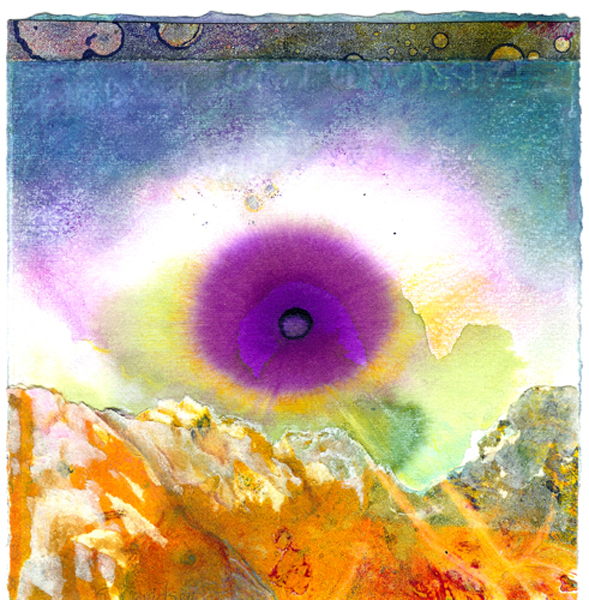
Seed Story I ingredients: monotype, watercolor pencils, metallic gel pens, stitching
This is the first of three pieces I'm going to have in a traveling exhibit curated by multi-talented artist and Northern Kentucky University instructor Paige Wideman. You'll probably want to check out Paige's website; she does some very cool work in a wide variety of media.
All of the pieces in the show have to be no more than 2 1/2 x 3 1/2 inches. This was kind of challenging for me- you know how much stuff I usually put in my work - but I learned a lot. I'll let you know the when's and where's of the exhibit as soon as I get the info.
And stay tuned- Seed Stories II and III will be posted soon!
I have finished one of the pieces from my "Work in Progress" post, and wanted to show you what it looks like in its final incarnation.
The title of the piece is Vernal Equinox, partly because I started working on it around that time, but also because these were the pathways around which my mind traveled as I made it. According to Wikipedia, an equinox occurs "... when the tilt of the Earth's axis is inclined neither away from nor towards the Sun, the center of the Sun being in the same plane as the Earth's equator."
illustration from Wikipedia
There are two equinoxes, one around March 20th (vernal), and the other on or near September 22nd (autumnal). On these two days, the length of the day and night are equal- hence, equinox. Originally the festival of the pagan fertility goddess Ostara (Oestre), the date of Easter is calculated as the first Sunday after the first full moon after the vernal equinox. From the equinox until the solstice, the days lengthen; it is the day that "light overcomes the darkness". Since it was the first new work I had begun since sometime before Christmas, and the spring equinox signifies renewal and rebirth, it seemed a fitting title.
Usually, I simply list the ingredients of the piece underneath the photo, but I thought that this time, it would be fun to do a pictorial list instead. As you can see, I'm easily amused!
I suppose this could be categorized as either a material and/or a technique-decollage is exactly what it sounds like. First, you collage; then, you de-collage- also known as tearing off what you just glued on. It seems like this would just be a slow way of getting nowhere, but it can create some interesting textural effects that you couldn't get any other way. In the case of this piece, I took some of the ripped-off pieces and glued them onto my substrate. Upside-down, actually- I used the back side of the papers as the front. I hope that wasn't too confusing?
Found objects: here are some of the objects in one of my drawers marked, "metal things".
Soft pastels: I used a mixture of reds to get that reddish-salmon color for the background of the upper part of the piece.
Embroidery floss was used for the stitching. I keep buying more colors, so now there's not enough room for all of them in the box; consequently, it's a mess. Time to get a bigger box.
Metallic pens: I originally bought these Pentel Slicci pens to use with the guest book for my daughter's wedding. They write very smoothly, and seem to resist drying out.
Gold paint crayon- It's very hard to find these any more, but I just bought this one on etsy!
Acrylic gel medium- you can never have too much, right?
Brass mini-brads- not even I am pathetic enough to get excited about a photo of brads.
Well, the pictorial list was a lot more work than the usual way, but I kind of like it! What do you think? Now that school is out, I hope to be posting a bit more regularly. A demain!
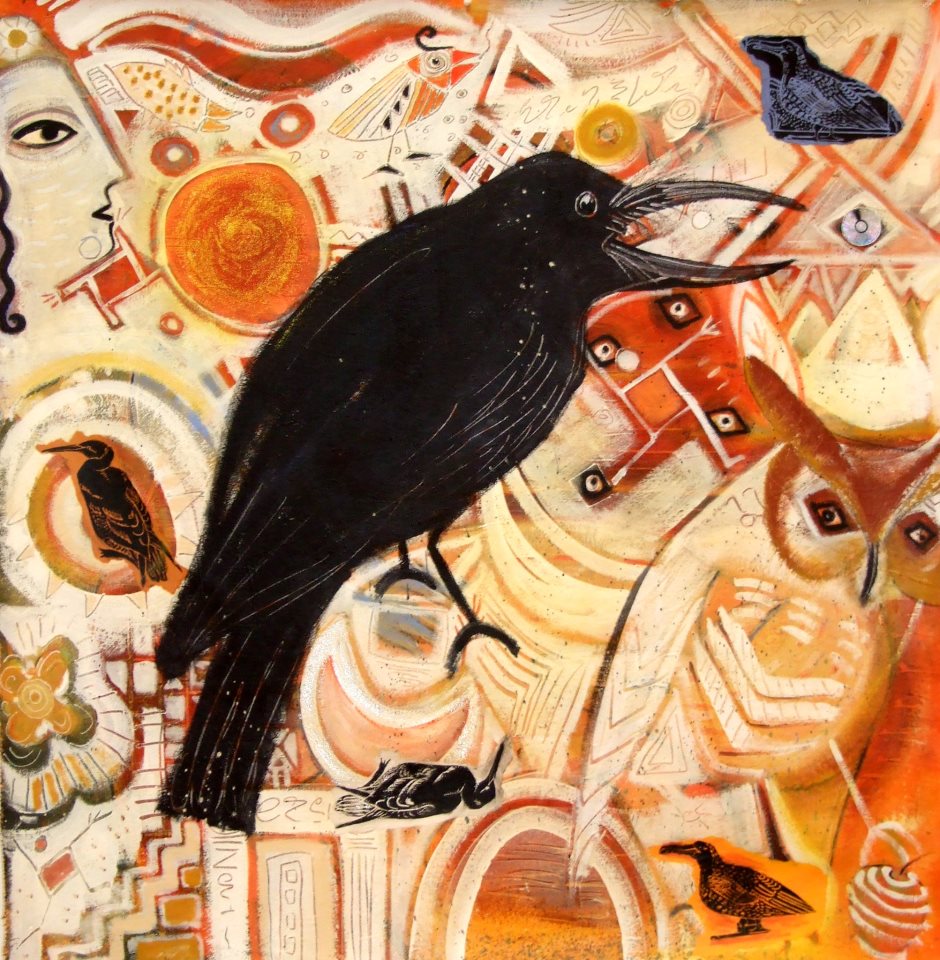
Once again, I bring you further evidence that art can never be too full of birds. In my last post, we looked at the origin of birds in art, and some early examples as well as a few contemporary ones. These are all contemporary, spanning a wide range of styles, methods, and media.
Fred Tomaselli, Big Raven
I think his process is fascinating...
Fred Tomaselli, Work in Progress
A free bird leaps on the back of the wind and floats downstream till the current ends and dips his wing in the orange suns rays and dares to claim the sky... ... But a caged bird stands on the grave of dreams his shadow shouts on a nightmare scream his wings are clipped and his feet are tied so he opens his throat to sing... - Maya Angelou, excerpt from I Know Why the Caged Bird Sings
Some birds are not meant to be caged, that's all. Their feathers are too bright, their songs too sweet and wild. So you let them go, or when you open the cage to feed them they somehow fly out past you. And the part of you that knows it was wrong to imprison them in the first place rejoices, but still, the place where you live is that much more drab and empty for thier departure.
-Stephen King, Rita Hayworth and Shawshank Redemption: A Story from Different Seasons
Birds sing after a storm; why shouldn't people feel as free to delight in whatever sunlight remains to them? - Rose Kennady
And then, just when you think you've seen it all, there's the uniquely exquisite work of Chris Maynard, who actually cuts tiny bird compositions from feathers. How he does it is beyond me; I'd surely be pulling my hair out in frustration if I tried something like this. I'm pretty sure it's done by magic; I think you'll agree.
According to the artist, "Feathers mark nature's pinnacle of achievement: the intersection of function and beauty."To find out more about Chris and his work, including where he gets the feathers, go here.
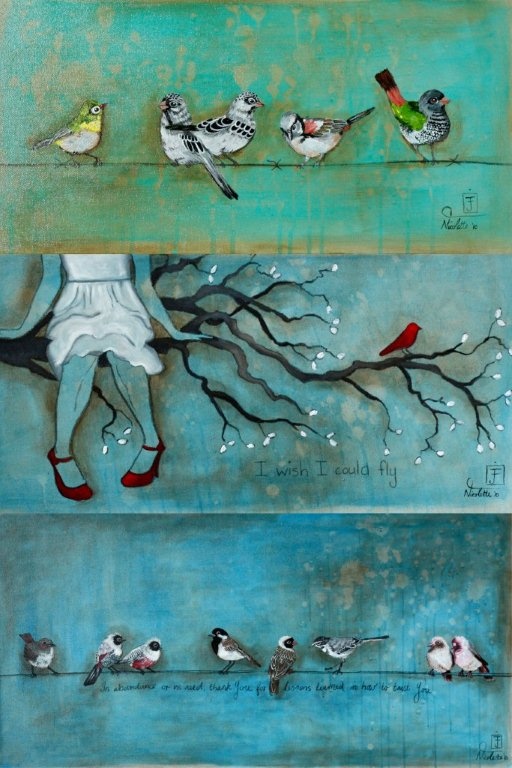
I love this piece, entitled, "I Wish I could Fly", but don't know who the artist is. If you do, please let me know; I would like to credit him/her. [ Update: The artist who made this piece contacted me; I'm happy to now be able to tell you that it was done by South African artist Nicolette Geldenhuys.] I wish I could fly, too- don't we all? I guess that's why humans are so enamored with these graceful, gravity-defying creatures. But unfortunately, we can't. So whenever you feel sad and blue, just do what I do...
I recently read a comment (or was it a "tweet"?!) about the supposed "over-use" of bird images in art right now. I, for one, beg to differ- and so do Portlandia's Lisa and Bryce:
Ha! I love that!
Birds have been a favorite subject and symbol portrayed in art since the beginning of... well... art. In fact, what may well be the earliest rock pictograph ever incorporates a bird image.
According to archaeologist Robert Gunn, "...a rock painting that appears to be of a bird that went extinct about 40,000 years ago has been discovered in northern Australia. If confirmed, this would be the oldest rock art anywhere in the world..." (Robert Gunn, 40,000 Year Old Rock Art Site Depicts Extinct Bird, News Junkie Post.)
one of many identical stenciled birds at Djulirri Rock Shelter
A stork or heron-like bird called the benu, an Egyptian bird thought to be the origin of the mythological phoenix.
Why have birds so captured our imaginations? Not so long ago, if you think about it, humans must have believed them to be magical beings, perhaps related to gods or spirits. No one could have comprehended their amazing and mysterious gift of flight; even a rudimentary knowledge of the underlying physics didn't exist until the 1600's. Their melodious songs and beautiful, sometimes brightly colored feathers would have only reinforced this perception.
In Hindu mythology, a half-bird half-human creature called Garuda carries Vishnu and his wife on his back.
Birds have always played an important part in the symbolism, myths, and folktales of many cultures. "Rising above the earth and soaring through the skies, birds have been symbols of power and freedom throughout the ages. In many myths and legends, birds link the human world to the divine or supernatural realms that lie beyond ordinary experience." For more information about the role of birds in mythology, go here.
Roman wall painting, about AD 70
John Burroughs (1837-1921) wrote, "The very idea of a bird is a symbol and a suggestion to the poet. A bird seems to be at the top of the scale, so vehement and intense his life... The beautiful vagabonds, endowed with every grace, masters of all climes, and knowing no bounds -- how many human aspirations are realised in their free, holiday-lives -- and how many suggestions to the poet in their flight and song!"
Ivory-billed Woodpecker by John James Audubon
When you think of art and birds, one of the first names to pop into your head might well be that of John James Audubon (1785-1851), a famous self-taught scientist and artist who spent 18 years of his life in an attempt to paint and describe all the birds of America, and discovering many unknown species along the way. The result was "The Birds of America", a collection of 435 prints of his naturalistic and extremely detailed life-sized paintings.
White Gyrfalcons by John James Audubon
I feel I would be remiss if I didn't mention Charles Darwin, particulary because of his use of bird drawings to illustrate and support his theory of natural selection. Darwin noted that the beaks of several species of finches living on the Galapogos Islands varied from island to island, but correlated to the type of food available to them on each island.
Darwin's drawing of the beak shapes of some finch species on the Galapogos Islands.
There are so many ways in which artists have 'put a bird on it' that I never grow tired of looking at them. I'm completely amazed and intrigued by the limitless variety of methods, media, and styles that have been used to portray birds. Here are a few examples:
Inuit artist Mayoreak Ashoona, Tuulirjuaq (Great Big Loon), stencil and stone cut
Ancient ibis painting copied by Howard Carter (discoverer of King Tut's tomb) from a tomb in Egypt.
Swiss artist Elfi Cella often includes birds in her brilliant mixed media paintings. If you're not familiar with her work, click on her name to check it out.
This untitled piece by Lynne Hoppe never fails to touch me... something about the mixture of emotions it evokes, which I can 't quite put into words...
One of my favorite pieces by one of my favorite collage artists, Dick Allowatt- Navigator.
The Ornithologist, 2008, acrylic with mixed media by Donna Iona Drozda




.jpg)