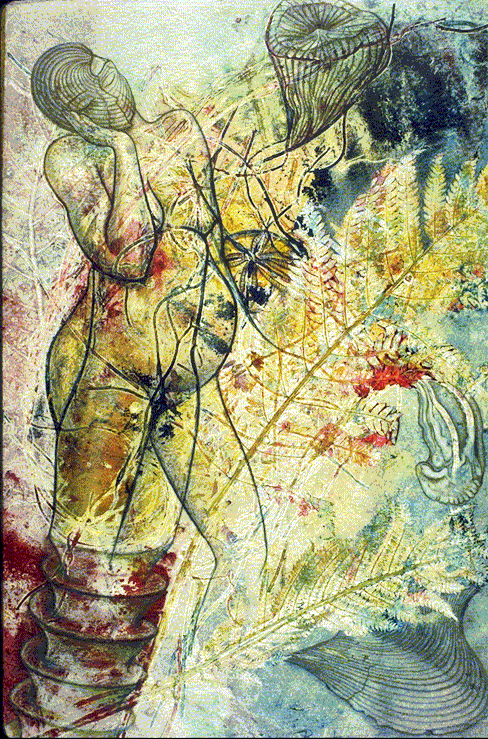
I finished this piece over a month ago, but have had some issues with getting things photographed due to my camera not working and the weather not cooperating (to say the least!). It's hard for me to describe what this piece is about, so I'll just say it's about essence. I was going to title it Between the Veils, but maybe Essence would be a better title.
ingredients: vintage book cover, pages, and spine; image transfer, drawing, collage, stitching, feathers, watercolor pencils
One of my favorite art instructors was/is well known for asking us the tough questions. First and foremost: What is it about?
"Yes, I see what it is," she'd say, "but what is it about?" What it is and what it's about are rarely one and the same when it comes to art. As artists, we want our work to communicate something to the viewer, but a painting of an apple does not necessarily mean to convey the idea, "here's an apple." Visual art, like a written passage, is not very satisfying if it doesn't require you to make inferences. Most readers/viewers will tend to feel cheated if the creator of the work hits them over the head with their message, and it's also just not very interesting.
When I showed my latest piece to my family on Christmas day, my son-in-law wanted to know what I was thinking when I made it; he wanted to know what it's about. A legitimate question, but for me, it's not always an easy one to answer. I mean, I know what it's about, but it's always difficult to put it into words. After all, if I were good at putting words together, I'd be a writer, not an artist. For me, creating meaning from color and line and form is so much easier. But it's our responsibility, isn't it, to help others interpret what we've created.
Theory of Flight
ingredients: vintage book cover;vintage book pages, ledger page, children's writing paper and book parts; image transfers; vintage stamps; vintage map fragment; found objects; brass wire; acrylic ink; hand stitching; feathers
So here's what I told him :
I was thinking about flight, and how unlikely it seems. Like, how do things fly if they're heavier than air? I know there is a scientific mechanism, called lift, but really, when you think about it, it just defies common sense.
We talked about how there is a fundamental mystery about it, something we can't really fully understand just by using our senses. I guess the pulley and those other metal things represent the scientific theory, the causation of something happening, how it affects something else which causes something else to happen... and you have flight. But really, isn't it a bit like magic? The objects, feathers and drawing could just as easily represent a magic spell as something scientific.
As we discussed this, I felt like he 'got it', and was able to come to a deeper appreciation of the piece, as opposed to just seeing it as something decorative. And I was wondering what other artists think about this aspect of being creative. Do you think we should be able to talk about our work, or are the viewers 'on their own' so to speak? How much do you explain, and how much do you leave to their own interpretation?
p.s. I apologize for the terrible quality of the photo, but I have tried numerous times with a borrowed 'point-and-shoot', and they never come out totally in focus. Anyone know somebody with a used DSLR they want to sell?
Recently I saw a piece on a television news magazine which fascinated me, and has also brought up some interesting questions. It was about a four year-old artistic genius, whose paintings are selling for as much as $28,000.00. There are, and have been, many others. I'm not talking about older children whose work is obviously done with forethought and intention; it's the little ones who are touted as "abstract impressionist geniuses" that have me puzzled. Here is a short video about the aforementioned Aelita Andre, who began painting at the age of 11 months.
She's undoubtedly adorable, but is she really an artist? Wouldn't any toddler, presented the opportunity and access to materials, pour and splatter paint onto a canvas? It's hard to say, as most people don't allow their children to do this, and probably couldn't afford it even if they wanted to. I personally can't afford to buy that much paint for myself, and canvases cost a small fortune. Perhaps she is a genius, if only because her art has the sense of freedom and exuberance that most adults have lost.
A similar story from 2005 was that of 4 year-old prodigy Marla Olmstead, who may have been, it turned out, getting a bit too much "help" from her dad. 60 minutes investigated, and allegations flew: "Her coach is her father, Mark, who is often present when Marla paints. He can be heard on the tape, directing her, sometimes sternly: "Pssst …. Paint the red. Paint the red. You're driving me crazy. Paint the red." "If you paint, honey, like you were … This is not the way it should be." You can read the entire story here.
There was even a movie about it, which I haven't seen, but I have put it on my Netflix queue.
These are examples of a phenomenon that has occurred many times, for who knows how long, but child prodigies aren't really my focus here. It's the nature of what we call 'ART' that interests me. Can a toddler create art? Is intentionality a prerequisite, or can monkey do it? What about an elephant?
I used to feel bad when I first heard about paintings by the elephants at our zoo, primarily because their work sold for more than mine did. But the ones in Thailand are a completely different story, and I don't feel I'm qualified to comment on whether or not the elephants are mistreated. The question is, are they making art?
Of course, there's no definitive answer, since the subject itself is rather- er- subjective. But here are a few definitions to consider.
Art is form and content. To quote Shelley Esaak of About.com Art History, whose explanation is about as straightforward and succinct as any I've seen: "Art is form and content" means: All art consists of these two things. Form means:
The elements of art,
the principles of design and
the actual, physical materials that the artist has used.
Content, now, gets a little more tricky. Content is idea-based and means:
What the artist meant to portray,
what the artist actually did portray and
how we react, as individuals, to both the intended and actual messages.
Additionally, content includes ways in which a work was influenced--by religion, or politics, or society in general, or even the artist's use of hallucinogenic substances--at the time it was created. All of these factors, together, make up the content side of art."
Kevin Cornell, of the very cool Bareskinrug blog, has come to believe that "art is not created; rather something created becomes Art. Something becomes Art when it is cherished; when we become attached to something for its uniqueness, for its faults and for its successes. An old fire hydrant, where the paint has cracked in a way you've never seen, where you stood and waited for the bus every day for 14 years, as familiar as family, can be as beautiful and unique and personal as a Monet. Those of us who are commonly termed Artists, are merely craftsmen, like a carpenter, or a plumber, or a journalist... if we're lucky, once in a while we do our job in such a way that it becomes unique, and it becomes loved for its uniqueness. Art is as often a product of accident as intent, and on the whole is mostly serendipitous." (italics mine)
Hmmmmmmmmm...
And then, there's the film "Exit Through the Gift Shop". If you aren't familiar, it's a documentary about a guy who accidentally becomes a famous artist mainly due to the fact that he likes to film- well- everything.
If you haven't seen this film, you really should. It will make you think, it will crack you up, and probably piss you off. It will definitely make you wonder, "What is art?"
* I came upon this re-post of two of my favorite blog posts while I was looking for copy for my new website. While I no longer work a day job, everything I said about time still applies, except that now I don't have time to make art because I'm busy with the business of trying to get my art out there - and maybe even make some money. And yes, I'm aware of how lucky I am. And of the irony. Go figure.
In choosing my re-post for Seth Apter's Buried Treasure collaboration, I looked back through my posts with an eye to 1) what seemed to resonate with my readers, and 2) what still resonated most with me. In the end, I chose 2 posts which address questions about the importance of art from the artist's perspective; in other words, why do we do it, and is it worth it? I hope you like them.
What is Art Good For?(9/16/10)
This isn't really a philosophical discussion, as much as just my own personal opinion and perspective. I mean, I guess philosophy and opinions could be related, as in, "How many angels do you think can dance on the head of a pin?", but that's neither here nor there. For some reason this has been spinning around in my head lately, so I'll just throw it out there, because- frankly- I need the room in my head for other things.
Fossil Memory
It's hard to know where to start, so I guess in the middle would be as good a place as any. When I began working as a special education teacher, I was also going to school to obtain my master's degree, as a condition of keeping my job. The lack of time, two kids to support, and a SO (significant other) who put all my art stuff into the attic made it all but impossible for me to make art. I rationalized it to myself this way: "What good is art, anyway? It doesn't bring in any money, and I'm completely broke. It doesn't mean a thing to most people, except maybe as a way to decorate their living rooms." I told myself, " It doesn't help anyone; no one needs art."
I was almost able to convince myself that this was the truth; after all, the idea was founded on perfectly sound logic. I believed I didn't need it either, that I could satisfy my creative drive in other ways, such as by building a log house. That helped, but didn't quite get to the heart of the matter, and as time went on I felt as if my heart had a hole in it- an empty place where art-making used to be.
How had I so quickly forgotten the lessons of the past? Looking back on it now, I can remember many times when art literally saved my life, or at least my sanity (yes, I still had some at one time!). When I was teaching art in an elementary school -without an art room, I had to carry my supplies from room to room- and my kids were still quite young, I would come home totally exhausted. So, instead of working on any large, planned piece, I would relax at night by painting these completely spontaneous, quick little watercolors.
Gently swishing the paint around with the soft brush helped me to relax and unwind. It functioned as a form of meditation...
...allowing some of the day's stress to melt away, and reassuring me that I could still make art, even if it was only a little.
And, when my first marriage was failing, and I felt I would surely lose my mind if I didn't find a job...
Against the Tide
Waiting for the Storm
... painting these pieces allowed me to channel my emotions in a constructive way, helped me to work through some of the scary twists and turns my life was taking...
The Speed of Darkness
... and basically kept me from freaking out completely or jumping off a bridge.
So, for me, this is one of the things art is good for.
Here's How It Is (2/7/11)
Well, here's how it is: I am a bad blogger. At least, that's how I feel sometimes- not guilty, really- just kind of disappointed that I've been unable to keep all the balls in the air.
"Jugglers at the Cirque Fernando" by Renoir
I can't post every day, or even every other day. Right now, I'm lucky if I can post once a week. I feel bad when I don't have enough time to leave witty and insightful comments on all of my friends' posts, if I even get a chance to look at them. Admittedly, I feel at times like I'm seeing them the way one sees the gorgeously tantalizing flowers in the neighbor's garden from the window of a speeding car.
I feel inadequate, but all I can say in my own defense is that even the best juggler (which I certainly am not) can get caught up in trying to juggle more balls than he/she can handle without the addition of some extra appendages. (Yes, I realize I'm mixing my metaphors again; it's like a big ol' metaphor soup up in here.)
"The Egyptian Juggler" by Sir Lawrence Alma Tadema
So, I've been wracking my brain about how I could resolve this problem. It came to me like a bolt of lightening out of the sky (no, that's a simile!)- there really is no way to solve this conundrum short of somehow bending time.
This may be possible in theory, but not even Einstein had the slightest inkling how to apply it to our every day lives.
But then I was reading a post on Rice Freeman-Zachery's wonderful blog, Notes from the Voodoo Cafe, that made me feel a bit better about the whole thing. She says this about working artists:
"You try to get in touch with them, and they don't respond, and you think, scornfully, "Diva!" But that's most often not it (sometimes that's it, but not very often). Usually it's because they have a certain day of the week in which they respond to email because the other days are a flurry of all the various things they have to do to try to stay afloat in an economy that bites and a culture that doesn't value working artists."
She goes on to say that most of us have to decide what we're going to give up in order to make art a priority, such as TV and the internet (except for blogging, of course). I have to agree; it's all about prioritizing. I rarely watch TV, except for the news and a couple of other shows. I don't have a social life, and my house probably isn't the cleanest, if you know what I mean. My husband graciously does most of the cooking. I try to answer emails, but sometimes it takes me a while. Sometimes I forget to respond to comments on my blog posts, but that's due to the age of my brain, and is not at all intentional.
I used to try to accept the fact that I didn't have the time to make art, but I failed in that effort, because I was miserable. I came to realize that I would have to make that time by deciding not to spend it on other things, like watching TV, or going out for drinks. If I have to cook, I'm probably not going to make something that takes three hours to prepare, and I made a deal with the dust bunnies that if they don't look at me, I won't look at them. If I have to work a full time job, then shouldn't part of the reward for that be that I get to spend my off-time doing something I love?
The Traveler's Tale: Balance
It's a balancing act, without a doubt- full time job, making art, marketing the art, etc.- but it's something I have to keep trying to work out as best I can. We may not be able to adjust time, but we can adjust our thinking. It really is, ultimately, all in how we look at it.
I added this to the end, because I think it expresses these ideas in a very creative and unique way. I saw this somewhere a long time ago, then recently again on C. Wright's Art Gallery blog.
Music Video for Tanya Davis's Song Art, by Andrea Dorfman
Recently I saw a piece on a television news magazine which fascinated me, and has also brought up some interesting questions. It was about a four year-old artistic genius, whose paintings are selling for as much as $28,000.00. There are, and have been, many others. I'm not talking about older children whose work is obviously done with forethought and intention; it's the little ones who are touted as "abstract impressionist geniuses" that have me puzzled. Here is a short video about the aforementioned Aelita Andre, who began painting at the age of 11 months.
She's undoubtedly adorable, but is she really an artist? Wouldn't any toddler, presented the opportunity and access to materials, pour and splatter paint onto a canvas? It's hard to say, as most people don't allow their children to do this, and probably couldn't afford it even if they wanted to. I personally can't afford to buy that much paint for myself, and canvases cost a small fortune. Perhaps she is a genius, if only because her art has the sense of freedom and exuberance that most adults have lost.
A similar story from 2005 was that of 4 year-old prodigy Marla Olmstead, who may have been, it turned out, getting a bit too much "help" from her dad. 60 minutes investigated, and allegations flew: "Her coach is her father, Mark, who is often present when Marla paints. He can be heard on the tape, directing her, sometimes sternly: "Pssst …. Paint the red. Paint the red. You're driving me crazy. Paint the red." "If you paint, honey, like you were … This is not the way it should be." You can read the entire story here.
There was even a movie about it, which I haven't seen, but I have put it on my Netflix queue.
These are examples of a phenomenon that has occurred many times, for who knows how long, but child prodigies aren't really my focus here. It's the nature of what we call 'ART' that interests me. Can a toddler create art? Is intentionality a prerequisite, or can monkey do it? What about an elephant?
I used to feel bad when I first heard about paintings by the elephants at our zoo, primarily because they sold their work for more than what mine sold for. But the ones in Thailand are a completely different story, and I don't feel I'm qualified to comment on whether or not the elephants are mistreated. The question is, are they making art?
Of course, there's no definitive answer, since the subject itself is rather- er- subjective. But here are a few definitions to consider.
Art is form and content. To quote Shelley Esaak of About.com Art History, whose explanation is about as straightforward and succinct as any I've seen: "Art is form and content" means: All art consists of these two things. Form means:
The elements of art,
the principles of design and
the actual, physical materials that the artist has used.
Content, now, gets a little more tricky. Content is idea-based and means:
What the artist meant to portray,
what the artist actually did portray and
how we react, as individuals, to both the intended and actual messages.
Additionally, content includes ways in which a work was influenced--by religion, or politics, or society in general, or even the artist's use of hallucinogenic substances--at the time it was created. All of these factors, together, make up the content side of art."
Kevin Cornell, of the very cool Bareskinrug blog, has come to believe that "art is not created; rather something created becomes Art. Something becomes Art when it is cherished; when we become attached to something for its uniqueness, for its faults and for its successes. An old fire hydrant, where the paint has cracked in a way you've never seen, where you stood and waited for the bus every day for 14 years, as familiar as family, can be as beautiful and unique and personal as a Monet. Those of us who are commonly termed Artists, are merely craftsmen, like a carpenter, or a plumber, or a journalist... if we're lucky, once in a while we do our job in such a way that it becomes unique, and it becomes loved for its uniqueness. Art is as often a product of accident as intent, and on the whole is mostly serendipitous." (italics mine)
Hmmmmmmmmm...
And then, there's the film "Exit Through the Gift Shop". If you aren't familiar, it's a documentary about a guy who accidentally becomes a famous artist mainly due to the fact that he likes to film- well- everything.
If you haven't seen this film, you really should. It will make you think, it will crack you up, and probably piss you off. It will definitely make you wonder, "What is art?"